
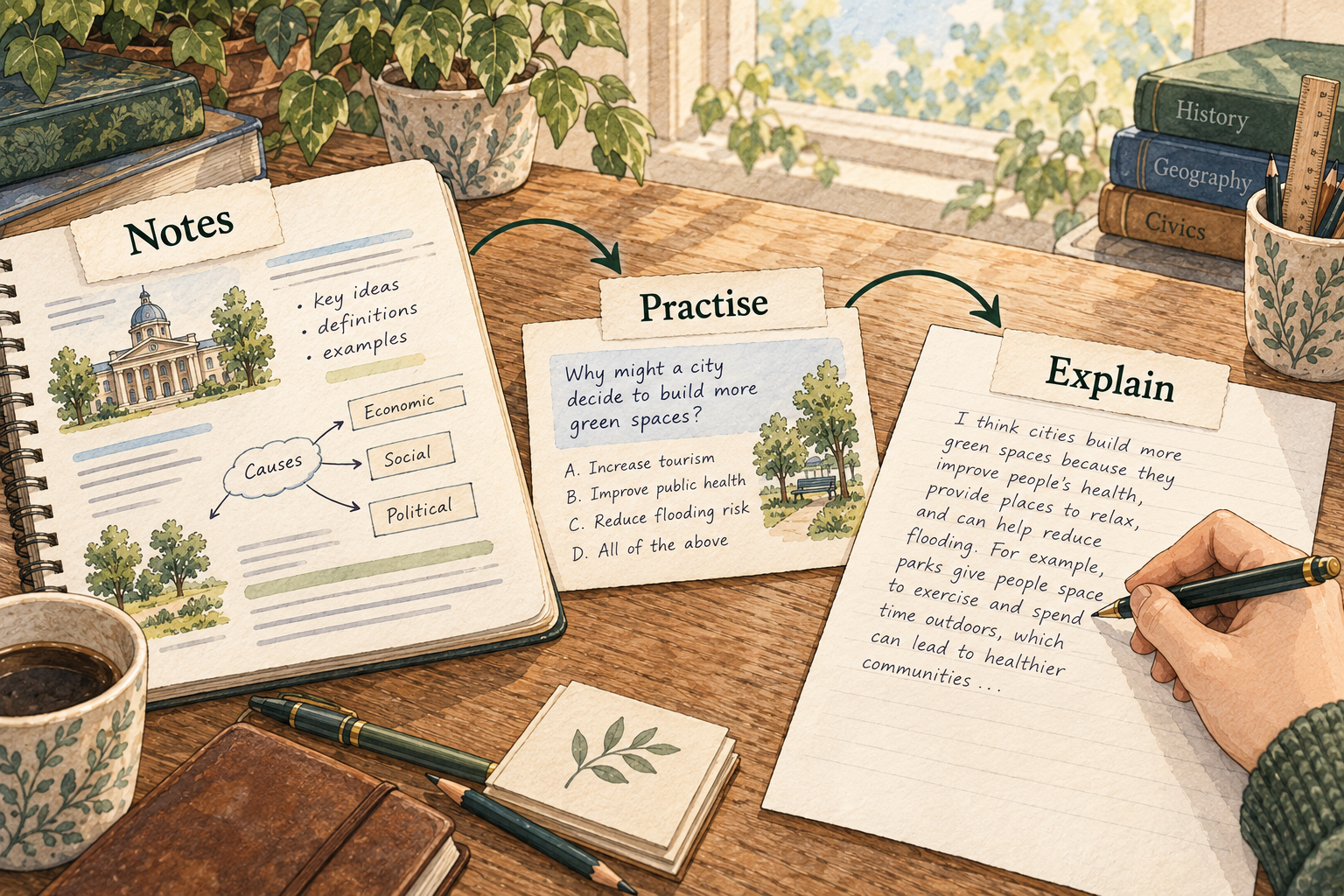
The best starting task is one that makes you do more of the thinking you need to learn. An agent can organize a study session, ask practice questions and help you find a gap in your explanation. It cannot demonstrate your understanding for you.
Suppose you have a lecture outline about photosynthesis. Instead of asking for a finished assignment, ask for five practice questions based only on that outline. Answer them yourself. Then ask the agent to compare your answers with the supplied material and identify the exact point you missed. That produces something you can check against the class, rather than another document to memorize.
Check the rules before choosing the task
A course may allow study assistance while restricting assistance on assessed work. Read the assignment instructions and ask your teacher when the boundary is unclear. Do not assume that a tool being available means you may submit its output. UNESCO’s education guidance discusses human agency and responsible institutional use; your own course rules determine what is allowed in your class.
Keep graded questions, classmates’ work and private feedback out of an initial experiment. Use your own short notes or a public reading you are permitted to share. If you need an accommodation or help with a difficult concept, an instructor can tell you which resources fit the course.
A study session you can inspect
Start with one topic, not a whole semester. Tell the agent which notes count as the source and how long you have. Ask it to teach through questions rather than immediately revealing an answer.
A suggested prompt: “Use these notes to ask five short practice questions, one at a time. Wait for my answer. Compare it with the notes and explain one mistake or omission. Give me another question about that point. Do not complete an assignment or invent facts absent from the notes.”
Read its correction against the actual notes. If it marks a correct answer wrong, point to the passage and ask it to explain the disagreement. An agent can sound encouraging while misunderstanding the subject. Your textbook, teacher and original sources remain useful checks.
After the session, write a short explanation from memory without the agent. Compare that explanation with the source. This separate attempt tells you more about learning than the length of the conversation. Save the concepts you still cannot explain as questions for your next class or study group.
What to keep and what to reject
Keep a list of your weak topics, corrected explanations and source locations. Reject made-up quotations, references you cannot find and answers that use a method your course has not taught without explaining it. If the agent introduces unfamiliar terminology, ask for the ordinary meaning and then check whether it belongs in the lesson.
For mathematics, ask for the reasoning behind a step, then redo the problem on your own. For writing, ask which part of your argument is unsupported rather than requesting a replacement essay. For language practice, ask for a correction and an explanation, then try another sentence yourself. These are different learning jobs; one generic “study assistant” instruction will not suit all three.
Keep account access separate from learning
A text-based practice session does not need your learning-platform login, email or calendar. Adding deadlines manually can be enough for a first study plan. Check every date against the course schedule before relying on it. Never ask an agent to submit assessed work just because it can operate a browser.
Choose a tool by what you can verify: can it stay within your supplied reading, wait for your answer and show the reason for a correction? After two sessions, compare whether you can explain more without help. If you only have neater notes, change the exercise before adding more automation.