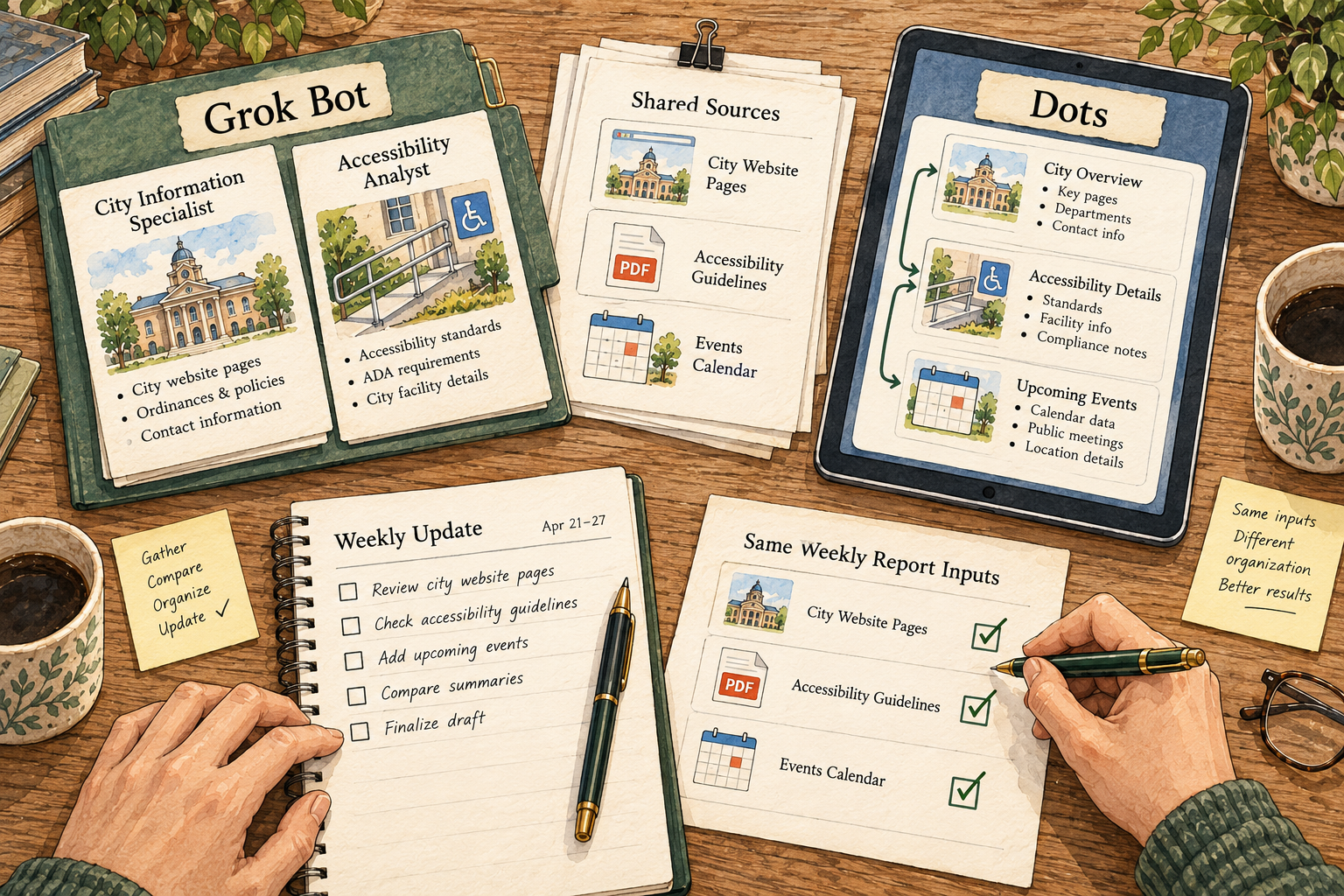
Grok Bot and Muse both do work beyond replying in chat. The more useful question is how you want to organize that work. Would you rather give named teammates particular jobs, or work with a personal agent around goals that overlap throughout your day?
Grok Bot makes the named role a central part of the experience. Muse puts a continuing personal relationship and goals at the center. That does not make Grok exclusively for business or Muse exclusively for home. It gives you two different starting points for a working arrangement.
Our recommendation is to choose an organization style that makes your work easier to review. More Bots can create more handoffs. One continuing conversation can carry too much mixed context. Either can be useful, but neither is automatically simpler once real work arrives.
The practical comparison
| Question | Grok Bot | Muse |
|---|---|---|
| How do you divide work? | Named Bots with distinct jobs and conversations | A personal agent with goals and side chats |
| What is the shared workspace? | Account-level cloud computer used by your Bots | Dedicated Muse computer with files and browser |
| How do you make work repeat? | Save a method as a skill and assign a routine | Continue a goal with scheduled or event-related work |
| What needs special attention? | Role separation does not separate files or logins | Personal context can influence several ongoing goals |
| Where is your review? | Inspect returned files, computer work and approvals | Inspect artifacts, goal progress, activity and approvals |
The product mechanisms come from Grok Bot’s role documentation, its computer model and Muse’s design explanation. The recommendation below is our interpretation of what those mechanisms mean for a beginner.
A role is useful when its responsibility stays stable
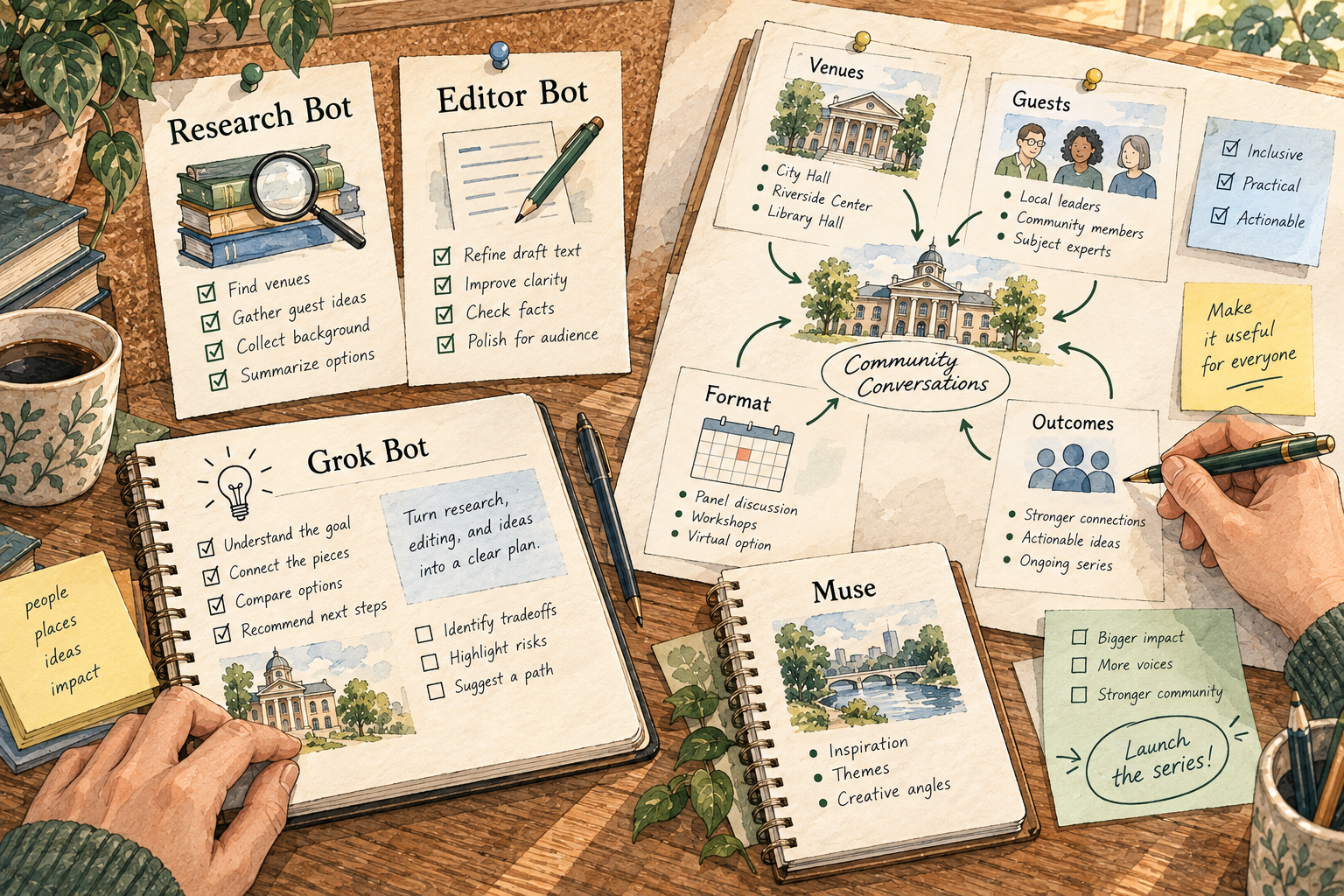
A named Bot gives a repeating job somewhere to accumulate instructions. You might have a Research Bot responsible for gathering sources and an Editor Bot responsible for checking whether a proposed article actually answers a reader’s question. Those are illustrative roles, not supplied product templates or a workflow we tested.
The distinction is useful only if the responsibility is clear. “Help with marketing” is vague. “Prepare a weekly list of customer questions with source links; do not contact customers” gives you a result and a boundary to inspect. Creating three vaguely named Bots does not resolve the ambiguity.
Grok’s documentation distinguishes durable profile instructions from task-specific messages. That lets you separate a lasting rule from this week’s assignment. In the example, the instruction to leave messages unsent belongs with the role; the three topics for this week belong with the task.
Muse offers another way to hold related work together: a continuing goal. If you are preparing a community workshop, venue research, a materials list and a reminder plan may belong to one goal. You do not necessarily need a new teammate for each item. Ask for a plan that shows the outstanding decisions, then keep revising that plan as you learn more.
Different conversations are not different access boundaries
This is the Grok detail a newcomer can easily miss. All Bots on an account share the cloud computer’s files, browser sessions and sign-ins. Separate screens and conversation histories do not create separate security compartments. An Editor Bot may be a different role, but a file available on the shared computer remains available to the other Bots.
That matters if you were planning to put client A and client B into two Bot conversations and call the separation complete. It is not complete merely because their names differ. Decide which material belongs in that account and whether the source service itself can provide narrower access.
For Muse, review the connected services and the personal context you have supplied. A goal name is a useful organizer, not proof that information cannot affect another goal. For either system, a source with limited permissions is easier to reason about than a broad sign-in followed by an instruction to “ignore everything else.”
A first trial does not need account access. Use public sources and a fictional brief. You will learn something about the working style without making a complicated access decision at the same time.
Turning a good result into repeated work
Grok separates a skill, which describes how to perform a job, from a routine, which starts it again. See skills and routines. This is useful when the method should remain stable while the input changes.
Suppose your weekly brief always needs three sections: new developments, why they matter and questions to investigate. First get one brief right. Correct its source selection and the distinction between facts and opinions. Only then save the method for repetition. Otherwise you have scheduled a weak answer rather than improved the work.
For a personal goal, the review is different. A workshop plan may need a new venue this week and invitations next week. Repeating the same report is less important than keeping the next step consistent with the current plan. Ask Muse to identify what changed and why the next proposed action follows from it.
The real choice is therefore not “which one is proactive?” It is whether your job benefits from a stable method, an evolving plan, or both. Avoid a daily message that repeats yesterday’s unchanged task list. Give the agent a reason to contact you and a definition of what counts as meaningful progress.
Review the work where you will use it
Grok’s file documentation describes inspectable outputs such as documents, spreadsheets and unsent messages. Ask for the artifact you need, not just an account of what the Bot says it did. See files and results.
For the weekly research example, ask for a table with a source beside every factual row and a short editorial note explaining why a topic was included. An elegant paragraph is harder to audit if its sources are scattered somewhere else. If a source cannot be accessed, the row should say so rather than silently substitute a summary.
For a workshop plan, ask for dates, open decisions, estimated costs and the next action. Keep booked items visibly separate from suggestions. You should not need to infer from a cheerful message whether money was spent.
Neither tool’s generated artifact is proof that its content is correct. Review dates, links and assumptions. The amount of correction required is part of the cost of using the agent, even when the subscription price is attractive.
Control and cost are separate from personality
Grok documents approval policies and sensitive handoffs; Muse describes structured approvals and a separate action-checking system. Read Grok’s controls and Muse’s security explanation. A friendly avatar is not an access setting.
Give the agent a clear stop point: prepare the brief or proposed plan, then ask before sending, publishing or buying. Inspect the actual settings that apply. A conversational boundary is useful, but it should not be the only thing you understand about the permissions.
Grok access is tied to qualifying Cursor or linked individual subscriptions, with usage allowances. Cursor’s billing guide explains that linking subscriptions does not simply stack their included usage. Muse has free and paid access described in Meta’s rollout announcement. Compare your weekly workload with the current allowance, rather than treating access as unlimited work.
A useful way to try both
Give each system the same fictional workshop brief, three public sources and a fixed budget. Request a venue comparison and a preparation plan, with no bookings. Then add a conflicting date and ask for a revised version.
For Grok, start with one Bot responsible for the outcome. Add a second role only if you can explain the handoff it improves. For Muse, keep the plan within one goal and assess whether you can follow its progress without rereading the conversation.
Check whether both versions update the date everywhere, preserve source links and leave unconfirmed prices as estimates. Record the time you spend finding and correcting mistakes. This is a proposed exercise; we are not reporting a measured winner.
Which approach fits you?
Try Grok Bot if stable named responsibilities and reusable methods appeal to you, and you understand the shared-access model. Try Muse if you want to discuss a personal goal, follow its evolving plan and manage related decisions in one continuing relationship.
If you need strict separation between clients, verify the access arrangement before choosing either. If all you need is one source summary, a task-based tool may be enough. Read the Grok Bot profile and Muse profile before assigning an ongoing responsibility. The useful agent is the one that reduces your coordination work without making the review harder.